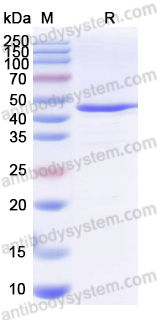
Antibody System Vosoritide ELISA Kit
Overview
This enzyme-linked immunosorbent assay (ELISA) kit is engineered for the precise quantitative determination of Vosoritide concentrations in serum and plasma samples. Vosoritide is a modified recombinant human C-type natriuretic peptide (CNP) analog comprised of 39 amino acids, featuring an extended N-terminus that prolongs its half-life by resisting neutral endopeptidase degradation. Administered primarily to treat achondroplasia—the most common form of human dwarfism—Vosoritide acts as a targeted therapeutic agent by binding specifically to Natriuretic Peptide Receptor B (NPR-B). This binding cascade inhibits the overactive Fibroblast Growth Factor Receptor 3 (FGFR3) signaling pathway, which downstream promotes endochondral bone growth and chondrocyte proliferation. This high-sensitivity competitive ELISA kit provides an essential analytical platform for clinical researchers, geneticists, and pharmacologists evaluating pharmacokinetic clearance profiles, drug bioequivalence, and patient-specific dosing regimens.
PRODUCT INFO
Principle of the Assay
This assay utilizes a high-performance, solid-phase quantitative competitive enzyme immunoassay technique to measure target drug levels:
-
Target Capture: An antibody specific for Vosoritide has been uniformly pre-coated onto the solid-phase surface of a 96-well microplate.
-
Competitive Binding: Calibrated standards or unknown biological samples are premixed with a biotin-labeled Vosoritide tracer molecule and then pipetted into the microwells. Endogenous Vosoritide present within the sample competes directly with the biotin-labeled tracer for a limited number of binding domains on the immobilized antibody.
-
Enzyme Conjugation: Unbound components are removed via a rigorous wash cycle. Streptavidin conjugated to Horseradish Peroxidase (Streptavidin-HRP) is introduced into the wells, anchoring specifically to the remaining captured biotin-labeled Vosoritide fractions.
-
Signal Amplification and Readout: Following a final wash to remove excess enzyme reagent, a colorimetric substrate solution is added to initiate enzymatic signal development. Because this is a competitive assay format, the resulting color intensity develops in inverse proportion to the concentration of active Vosoritide present in the initial sample matrix. The reaction is terminated with a stop solution, and absorbance is quantified spectrophotometrically.
Key Features and Performance Metrics
-
Refined Sensitivity Profile: Exhibits a lower limit of detection (LLD) down to 13.48 ng/mL, allowing investigators to monitor low-level therapeutic clearance and trough concentrations.
-
Focused Quantitative Range: Delivers a reliable linear range tracking from 15.63 ng/mL to 1,000 ng/mL to seamlessly accommodate precise sample concentrations.
-
Intra-Assay Precision Profile: Demonstrates consistent target reproducibility with a Coefficient of Variation (CV) of less than 20 percent, validated through sixteen separate replicate evaluations across three samples of known concentration on a single test plate.
-
Inter-Assay Precision Profile: Confirms high batch-to-batch and day-to-day experimental uniformity with a CV of less than 20 percent, verified across twenty-four distinct assay runs using three independent reference concentration samples.
Technical Specifications
-
Catalog No.: KDD59501
-
Assay Configuration: Quantitative Competitive Enzyme Immunoassay
-
Targeted Biomarker: Vosoritide (C-Type Natriuretic Peptide Analog)
-
Validated Matrices: Serum and Plasma
-
Assay Range: 15.63 to 1,000 ng/mL
-
Analytical Sensitivity: 13.48 ng/mL
-
Solid-Phase Target: Anti-Vosoritide Specific Antibody
-
Detection Enzyme Layer: Biotin-Vosoritide / Streptavidin-HRP Conjugate
Applications and Workflow Summary
This competitive ELISA platform is optimized for high-throughput pharmacological profiling and downstream clearance evaluations. Investigators should observe the following guidelines:
-
Dilution and Layout: Unknown serum or plasma matrices should be screened alongside the provided reference standards. Samples exhibiting concentrations exceeding the maximum range of 1,000 ng/mL must be diluted empirically in standard assay matrix buffer prior to running the assay.
-
Analysis Requirements: To achieve absolute quantification accuracy, investigators must generate a standard curve simultaneously during every plate run, plotting standard absorbance profiles against log-transformed concentration values.
Handling, Stability and Storage
-
Kit Shipping: Distributed under secure, temperature-controlled conditions on blue ice or chilled gel packs to preserve protein matrix and enzyme binding configurations.
-
Operational Shelf Life: When the kit is stored continuously at the recommended temperature for 6 months, the internal signal intensity and enzymatic reactivity profile degrade by less than 20 percent.
-
Storage Guidance: Keep the complete kit stored strictly at the manufacturer-specified refrigeration temperature upon receipt. Ensure that unused microplate wells remain sealed within their original desiccant pouch to guard against moisture compromise.
-