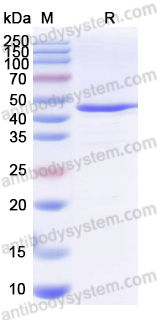
Antibody System IdeS Protease (IgG Specific)
Overview
This recombinant IdeS Protease is an exceptionally specific cysteine endopeptidase cloned from Streptococcus pyogenes and expressed in an optimized E. coli system. IdeS (Immunoglobulin-degrading enzyme from Streptococcus pyogenes) functions as a highly specialized tool in proteomics and biopharmaceutical characterization due to its unique structural restriction: it exclusively recognizes and cleaves human and animal Immunoglobulin G (IgG) subclasses. The enzyme operates via a highly regulated single-site proteolytic cleavage strictly below the IgG hinge region—specifically between consecutive glycine residues in the heavy chain (the GLLGGGPS sequence pattern).
This uniform enzymatic hydrolysis yields a single homogenous F(ab')2 fragment and two separate Fc monomers, avoiding the non-specific, over-digestion artifacts frequently observed with traditional proteases like papain or pepsin. This highly specialized enzyme provides an indispensable analytical asset for structural mass spectrometry, bottom-up proteomics, antibody-drug conjugate (ADC) subunit mapping, glycan profiling, and quality control monitoring during therapeutic monoclonal antibody manufacturing pipelines.
PRODUCT INFO
Key Features and Performance Metrics
-
Elite Biological Activity Profile: Formulated at a high concentration of 40000 U/ml, where one unit (1 U) is defined as the minimum enzyme quantity required to cleave 95 percent or more of 1 ug recombinant monoclonal IgG within 30 minutes at 37 degrees C.
-
Refined Proteomic Purity: Exhibits a structural purity exceeding 90 percent, quantified and verified via Sodium Dodecyl Sulfate-Polyacrylamide Gel Electrophoresis (SDS-PAGE) to guarantee a clean baseline absent of interfering cross-reactive proteins.
-
Precise Molecular Mass: Features a predicted recombinant molecular weight of 37.57 kDa, delivering high-yield expression metrics and stable liquid-phase molecular dynamics.
-
Streamlined Multi-Species Cleavage: Demonstrates rapid kinetics across a wide array of human, humanized, chimeric, and specific animal IgG templates, ensuring flexible deployment across global discovery assay platforms.
Technical Specifications
-
Catalog No.: YXX05001
-
Enzyme Family: Cysteine Endopeptidase (IgG-Specific)
-
Source Species: Streptococcus pyogenes
-
Expression System: E. coli
-
Nature: Recombinant
-
Stock Concentration: 40000 U/ml
-
Predicted Molecular Weight: 37.57 kDa
-
Validated Application: Proteomics, Structural Mass Spectrometry, and Subunit Characterization
-
Endotoxin Level: Batch-specific; please contact technical services for current certificate of analysis metrics.
Applications and Workflow Summary
This recombinant protease is highly optimized for performance in structural biopharma characterization, top-down middle-up mass spectrometry sequencing, and antibody domain fragmentation. Investigators should observe the following guidelines:
Standard Digestion Protocol
-
Sample Preparation: Standardize your IgG target within an appropriate reaction buffer. For a standard comprehensive reaction, scale up to 5 mg of target antibody per digestion layout.
-
Enzyme Calculations: Introduce the IdeS protease into your target IgG sample at a streamlined ratio of 1 unit (1 U) of IdeS per 1 ug of target IgG matrix.
-
Incubation Strategy: Incubate the mixed sample matrix uniformly at 37 degrees C for 30 to 60 minutes to achieve complete hinge-region cleavage.
Buffering and Reaction Suitability
-
Optimal Matrix: IdeS proteases display peak enzymatic activity profiles in biological buffers maintained at or near neutral pH boundaries.
-
Recommended Reaction Buffer: 50 mM sodium phosphate combined with 150 mM NaCl (adjusted to pH 6.6).
-
Alternative Buffers: Standard physiological options—including conventional Phosphate Buffered Saline (PBS) or Tris-based systems—are fully compatible. Digestion parameters using buffers falling well outside this neutral window (e.g., acidic acetate buffers) can be utilized but require empirical optimization of incubation duration or enzyme-to-substrate ratios.
Handling, Stability and Storage
-
Liquid Formulation: Supplied as a highly stable frozen liquid solution dissolved in 0.01M Phosphate Buffered Saline (PBS), pH 7.4, supplemented with 50 percent glycerol cryoprotectant to preserve enzyme folding dynamics.
-
Shipping Configurations: Distributed under secure, temperature-regulated parameters utilizing dry ice or chilled blue ice packs unless customized alternative shipping arrangements are established.
-
Storage Guidance:
-
Short-Term Storage: Maintain at 2 to 8 degrees C for standard short-term application needs (up to 1 week).
-
Long-Term Storage: For extended preservation, store continuously at -20 to -80 degrees C for a stable framework spanning 12 months from the initial date of batch receipt.
-
-
Operational Shelf Life: To avoid physical stress, structural denaturation, or sudden loss of catalytic activity, utilize a manual defrost freezer and strictly avoid repeated freeze-thaw cycles.
-