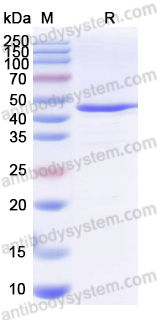
Antibody System Recombinant Endo S2 (Endo-beta-N-acetylglucosaminidase)
Overview
This recombinant Endo S2 (Endo-beta-N-acetylglucosaminidase) is a highly specific endoglycosidase cloned from Streptococcus pyogenes and expressed in an optimized E. coli system. Endo S2 serves as an essential tool in glycobiology, biopharmaceutical characterization, and middle-up mass spectrometry sequencing due to its unique structural restriction. The enzyme selectively recognizes and hydrolyzes the conserved N-linked glycans on the Fc region of Immunoglobulin G (IgG) and alpha-1-acid glycoprotein. It functions by cleaving the chitobiose core at the beta-1,4 linkage between the two internal N-acetylglucosamine (GlcNAc) residues.
A defining feature of Endo S2 is its remarkably broad glycan specificity compared to other endoglycosidases. It efficiently processes complex, hybrid, and high-mannose type N-glycans, leaving a single GlcNAc residue attached to the asparagine on the polypeptide backbone (with or without core alpha-1,6 fucosylation). This precise enzymatic activity makes it an invaluable analytical asset for rapid antibody deglycosylation, functional antibody-dependent cellular cytotoxicity (ADCC) validation studies, and routine quality control monitoring during therapeutic monoclonal antibody manufacturing pipelines.
PRODUCT INFO
Key Features and Performance Metrics
-
Broad N-Glycan Specificity: Successfully targets complex, hybrid, and high-mannose glycan profiles on IgG and alpha-1-acid glycoprotein templates.
-
Elite Biological Activity: One unit (1 U) is defined as the minimum enzyme quantity required to deglycosylate 95 percent or more of 1 ug human IgG within 30 minutes at 37 degrees C when incubated in a standard neutral phosphate buffer.
-
Refined Proteomic Purity: Exhibits a structural purity exceeding 90 percent, quantified and verified via Sodium Dodecyl Sulfate-Polyacrylamide Gel Electrophoresis (SDS-PAGE) to ensure a clean baseline absent of cross-contaminating proteases.
-
High Molecular Mass Architecture: Features a predicted recombinant molecular weight of 114.67 kDa, delivering stable solution-phase kinetics and reproducible multi-batch hydrolysis dynamics.
Technical Specifications
-
Catalog No.: YXX06601
-
Enzyme Family: Endoglycosidase / Endo-beta-N-acetylglucosaminidase
-
Source Species: Streptococcus pyogenes
-
Expression System: E. coli
-
Nature: Recombinant
-
Predicted Molecular Weight: 114.67 kDa
-
Form: Lyophilized Powder
-
Validated Applications: Hydrolysis of N-linked glycans on IgG frameworks and alpha-1-acid glycoproteins
-
Endotoxin Level: Batch-specific; please contact technical services for current certificate of analysis metrics.
Alternative Names: Endo S2, Endo-S2, EndoS2, Endo-beta-N-acetylglucosaminidase.
Applications and Workflow Summary
This recombinant endoglycosidase is highly optimized for performance in structural biopharma characterization, top-down middle-up mass spectrometry sequencing, and glycan profiling. Investigators should observe the following guidelines:
Reconstitution Protocol
-
Reconstituent Selection: Reconstitute the lyophilized powder in sterile, high-purity water to prepare your initial stock solution layout.
-
Mixing Technique: Swirl the vial gently until the cake or powder dissolves completely. Avoid vigorous vortexing or mechanical agitation to protect the large 114.67 kDa tertiary fold from structural denaturation.
Standard Digestion Conditions
-
Validated Assay Matrix: The standard operational framework utilizes 10 mM sodium phosphate combined with 150 mM NaCl, adjusted to a physiological pH of 7.4.
-
Incubation Parameters: Maintain the reaction uniformly at 37 degrees C for 30 minutes to achieve complete core chitobiose cleavage on standard IgG substrates.
-
Handling Precautions: To prevent physical shear stress or a sudden loss of catalytic activity, handle stock aliquots with care, work on ice during assay assembly, and centrifuge the vial briefly prior to opening to collect all contents.
Handling, Stability and Storage
-
Lyophilization Buffer: Formulated and lyophilized from a stable matrix solution containing PBS pH 7.4, 1mM EDTA, 4 percent trehalose, and 1 percent mannitol cryoprotectants.
-
Shipping Configurations: Distributed under secure, temperature-regulated parameters utilizing dry ice or chilled blue ice packs unless customized alternative shipping arrangements are established.
-
Storage Guidance:
-
Short-Term Storage: Maintain at 2 to 8 degrees C for immediate, short-term application needs (up to 1 week).
-
Long-Term Storage: For extended preservation, store the dry powder or properly aliquoted stock solution continuously at -20 to -80 degrees C for a stable framework spanning 12 months from the initial date of batch receipt.
-
-
Operational Shelf Life: To avoid physical stress, structural unfolding, or a sudden loss of endoglycosidase activity, utilize a manual defrost freezer and strictly avoid repeated freeze-thaw cycles.
-