Antibody System Research Grade Vixtimotamab
Overview
This research-grade monoclonal modality is engineered as a tetravalent, bispecific tandem diabody (TandAb) designed to simultaneously target Myeloid Cell Surface Antigen CD33 (Sialic acid-binding Ig-like lectin 3 / Siglec-3) on target myeloid cells and the Cluster of Differentiation 3 epsilon subunit (CD3e) on T-lymphocytes. CD33 is a 67 kDa transmembrane glycoprotein cell-surface receptor preferentially expressed on myeloid progenitor cells, mature monocytes, tissue macrophages, and aberrantly overexpressed on the malignant blasts of more than 85 percent to 90 percent of acute myeloid leukemia (AML) cases, as well as myeloid-derived suppressor cells (MDSCs) within the tumor microenvironment.
By concurrently bridging CD33-expressing target cells with the T-cell receptor complex via its CD3e binding domains, this bispecific construct forces the spatial alignment of a cytolytic immunological synapse. This unique tetravalent format incorporates two binding sites for CD33 and two binding sites for CD3, enabling highly avid target engagement and robust, localized T-cell activation. This redirection completely bypasses native major histocompatibility complex class I (MHC-I) antigen restriction, driving polarized exocytosis of perforins and granzymes, which culminates in the targeted cell lysis of CD33-positive neoplastic or suppressive myeloid lineages. Developed as a high-fidelity research-grade biosimilar based on clone AMV-564 (also known as TandAb T564 or CNTO-3953), vixtimotamab utilizes a specialized non-covalent tandem diabody configuration composed of four variable domains arranged in a single polypeptide chain that homodimerizes head-to-tail. This platform serves as an essential analytical tool for mapping multi-valent engagement kinetics, depleting immunosuppressive MDSCs, and profiling therapeutic response dynamics in preclinical AML and solid tumor models.
PRODUCT INFO
Key Features and Performance Metrics
-
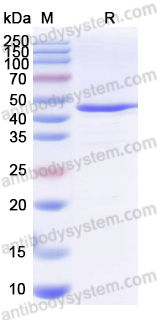
Refined Purity Profile: Exhibits an exceptional structural purity exceeding 95 percent, quantified and verified via Sodium Dodecyl Sulfate-Polyacrylamide Gel Electrophoresis (SDS-PAGE).
-
Focused Stock Concentration: Supplied at a standard working stock concentration of 0.62 mg/ml to support direct in vitro functional assays, co-culture cytotoxicity models, and serial titration layouts.
-
Tetravalent TandAb Architecture: Formatted with a specialized [V-kappa-VH-V-lambda-VH']-noncovalent dimer structural arrangement, providing two distinct binding domains for each target antigen to maximize cross-linking efficacy and enhance thermal stability.
-
Validated Upstream Recovery: Isolated and polished using specialized Protein A/G affinity chromatography directly from cell culture supernatants to minimize processing contaminants.
Technical Specifications
-
Catalog No.: DHD37506
-
Targeted Biomarkers: Myeloid cell surface antigen CD33 (Siglec-3) & CD3 epsilon chain (CD3E)
-
Host Species: Chimeric
-
Clonality: Monoclonal
-
Clone ID: Vixtimotamab (AMV-564 / TandAb T564)
-
Isotype: [V-kappa-VH-V-lambda-VH']-noncovalent dimer (Tandem Diabody)
-
Species Reactivity: Human
-
Accession Numbers: P20138 (CD33) & P07766 (CD3E)
-
Endotoxin Level: Batch-specific; please contact technical services for current certificate of analysis metrics.
Alternative Names: Tetravalent Bispecific CD33 x CD3, AMV-564, TandAb T564, CNTO 3953 TANDAB, CNTO-3953, T-652, gp67, SIGLEC3, T3E, CAS: 2243775-32-6.
Applications and Workflow Summary
This chimeric tetravalent molecule is highly optimized for performance as a research-grade biosimilar in downstream preclinical models. Investigators should observe the following guidelines:
-
Dilution and Layout: Optimal operational concentrations must be determined empirically based on specific assay configurations, such as T-cell-directed myeloid cell lysis screenings, cytokine (IFN-γ / TNF-α) induction profiling, flow cytometry-based receptor occupancy assays, or surface plasmon resonance (SPR) binding kinetics.
-
Matrix Suitability: Due to its multivalent targeting of CD33, this molecule is exceptionally suited for comparative functional screens against traditional bivalent antibody-drug conjugates (ADCs) to characterize off-tumor target depletion profiles and immune microenvironment repolarization.
-
Handling Precautions: To prevent physical shear stress, dissociation of the non-covalent dimer, or structural degradation of the tandem diabody linkages, handle stock aliquots with care and centrifuge the vial briefly prior to opening.
Handling, Stability and Storage
-
Liquid Formulation: Supplied in a highly stable liquid format dissolved in 0.01M Phosphate Buffered Saline (PBS), pH 7.4.
-
Storage Guidance:
-
Short-Term Storage: Maintain at 4°C for standard short-term use (1 to 2 weeks).
-
Long-Term Storage: For intermediate storage up to 12 months, keep at -20°C. For extended long-term preservation, store at -80°C.
-
-
Operational Shelf Life: To prevent structural chain fragmentation and preserve functional tetravalent bispecific binding capabilities across all active variable domains, use a manual defrost freezer and strictly avoid repeated freeze-thaw cycles.
-