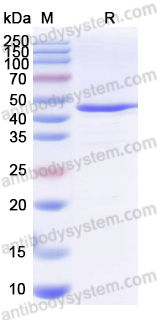
Antibody System Recombinant Bovine Terminal Transferase (TdT)
Overview
This recombinant Terminal Transferase (TdT) is a template-independent DNA polymerase cloned from bovine and expressed in an optimized E. coli system. Terminal deoxynucleotidyltransferase functions as a unique and indispensable tool in molecular biology, nucleic acid engineering, and synthetic biology due to its rare ability to synthesize DNA without a complementary template strand. The enzyme catalyzes the repetitive addition of deoxynucleotides (dNTPs) directly to the 3-prime hydroxyl (3'-OH) terminus of single-stranded or double-stranded DNA molecules.
To initiate synthesis, TdT requires an oligodeoxynucleotide initiator of at least three bases acting as a primer. Incorporating specific divalent cations significantly modulates the enzyme's relative nucleotide incorporation efficiency. While magnesium (Mg2+) supports standard extension, the addition of cobalt (Co2+) into the reaction matrix maximizes the efficiency of the tailing reaction, particularly when modifying blunt or recessed 3-prime ends. This enzyme provides an essential analytical platform for 3-prime end labeling of DNA with radioactive or non-radioactive tags, homopolymer tailing of vectors for cloning, synthetic gene assembly, and terminal tracking within TUNEL assays to detect apoptosis.
PRODUCT INFO
Key Features and Performance Metrics
-
Template-Independent Extension: Catalyzes the smooth synthesis of homopolymer or heteropolymer tails on single- or double-stranded DNA fragments completely free of template direction.
-
Refined Proteomic Purity: Exhibits a structural purity exceeding 90 percent, quantified and verified via Sodium Dodecyl Sulfate-Polyacrylamide Gel Electrophoresis (SDS-PAGE) to ensure a clean baseline absent of interfering exonuclease or endonuclease contaminants.
-
Precise Molecular Mass: Features a predicted recombinant molecular weight of 45 kDa, delivering high-yield operational kinetics and excellent solution-phase structural stability.
-
Concentration and Yield Optimization: Formulated at a clear stock concentration of 0.9 mg/ml to support direct integration into routine homopolymer tailing layouts, vector construction setups, and diagnostic labeling assays.
Technical Specifications
-
Catalog No.: YBC05501
-
Enzyme Family: Template-Independent DNA Polymerase
-
Source Species: Bovine
-
Expression System: E. coli
-
Nature: Recombinant
-
Stock Concentration: 0.9 mg/ml
-
Predicted Molecular Weight: 45 kDa
-
Validated Application: Catalytic addition of deoxynucleotides to the 3-prime hydroxyl terminus of DNA molecules
-
Endotoxin Level: Batch-specific; please contact technical services for current certificate of analysis metrics.
Alternative Names: DNA nucleotidylexotransferase, Terminal deoxynucleotidyltransferase, Terminal addition enzyme, TDT, DNTT, EC 2.7.7.31.
Applications and Workflow Summary
This recombinant bovine transferase is highly optimized for performance in 3-prime end homopolymer tailing, directed labeling protocols, and molecular cloning workflows. Investigators should observe the following guidelines:
-
Primer Requirements: Ensure your reaction system includes an oligodeoxynucleotide primer substrate possessing a length of at least three bases with an available, unblocked 3-prime hydroxyl group.
-
Tailing Optimization: For maximum tailing efficiency and uniform homopolymer extension (especially when working with blunt or 3-prime recessed DNA architectures), the introduction of cobalt ions (Co2+) into the reaction mixture is highly recommended.
-
Workflow Adjustments: Optimal operational enzyme volumes, dNTP concentrations, incubation temperatures, and durations vary depending on the desired length of the nucleotide tail and should be determined empirically by the investigator.
-
Handling Precautions: To prevent physical shear stress, misfolding, or a sudden loss of polymerase activity, handle stock aliquots with care, work on ice during reaction assembly, and centrifuge the vial briefly prior to opening.
Handling, Stability and Storage
-
Liquid Formulation: Supplied in a highly stable liquid format dissolved in 100mM KAc (pH 6.8), 2mM 2-mercaptoethanol, 0.01 percent Triton X-100, and 50 percent glycerol cryoprotectant to safeguard structural active-site dynamics.
-
Shipping Configurations: Distributed under secure, temperature-regulated parameters utilizing dry ice or chilled blue ice packs unless customized alternative shipping arrangements are established.
-
Storage Guidance:
-
Short-Term Storage: Maintain at 2 to 8 degrees C for immediate, short-term application needs (up to 1 week).
-
Long-Term Storage: For extended preservation, store continuously at -20 to -80 degrees C for a stable framework spanning 12 months from the initial date of batch receipt.
-
-
Operational Shelf Life: To avoid physical stress, structural denaturation, or a sudden loss of catalytic activity, utilize a manual defrost freezer and strictly avoid repeated freeze-thaw cycles.
-