Antibody System Recombinant PNGase F
Overview
This recombinant PNGase F (Peptide-N-Glycosidase F) is an exceptionally pure amidase cloned from Elizabethkingia miricola and expressed in an optimized E. coli system. PNGase F is an indispensable enzymatic tool in glycobiology, proteomics, and biopharmaceutical quality control. It catalyzes the smooth cleavage of almost all N-linked oligosaccharides from glycoproteins. The enzyme hydrolyzes the amide bond between the innermost N-acetylglucosamine (GlcNAc) and the asparagine residue, converting the asparagine into an aspartic acid.
This reaction effectively releases high-mannose, hybrid, and complex oligosaccharides from the polypeptide backbone. It provides researchers with a pristine, structural sample for subsequent glycan profiling. This high-concentration recombinant formulation is widely utilized for antibody characterization, mass spectrometry glycoproteomics, structural biology analysis, and therapeutic glycoprotein profiling pipelines.
PRODUCT INFO
Key Features and Performance Metrics
-
High Working Concentration: Supplied at a robust concentration of 50000 units/ml to support both high-throughput analytical screening and large-scale bulk protein deglycosylation workflows.
-
Rigorous Activity Definition: One unit (1 U) is defined as the specific amount of enzyme required to remove more than 95 percent of the carbohydrate content from 10 ug of denatured RNase B in 1 hour at 37 degrees C within a total reaction volume of 10 ul.
-
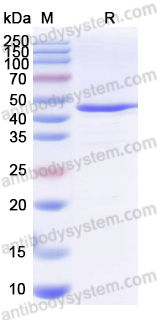
Premium Structural Purity: Exhibits an exceptional purity profile exceeding 95 percent, quantified and verified via Sodium Dodecyl Sulfate-Polyacrylamide Gel Electrophoresis (SDS-PAGE) to ensure zero cross-contaminating proteolytic activity.
-
Precise Molecular Configuration: Features a predicted recombinant molecular weight of 37.08 kDa, providing structural stability and reliable enzymatic kinetics across both native and denatured sample matrices.
Technical Specifications
-
Catalog No.: YXX04901
-
Enzyme Family: Amidohydrolase / Glycosidase (N-Glycan Specific)
-
Source Species: Elizabethkingia miricola
-
Expression System: E. coli
-
Nature: Recombinant
-
Stock Concentration: 50000 units/ml
-
Predicted Molecular Weight: 37.08 kDa
-
Validated Application: Removal of high mannose, hybrid, and complex N-glycans from target glycoproteins
-
Endotoxin Level: Batch-specific; please contact technical services for current certificate of analysis metrics.
Applications and Workflow Summary
This recombinant amidase is highly optimized for performance under both denaturing and non-denaturing (native) assay configurations. Investigators should follow these standardized operational protocols:
Denaturing Reaction Method
-
Sample Preparation: Combine 1 to 20 ug of your target glycoprotein, 1 ul of 10X Glycoprotein Denaturing Buffer (yielding a working framework of 0.5 percent SDS and 40 mM DTT), and water to establish a 10 ul total reaction volume.
-
Thermal Denaturation: Heat the reaction mix at 100 degrees C for 10 minutes to completely unfold the protein backbone. Chill on ice briefly and centrifuge for 10 seconds.
-
Reaction Adjustment: Expand the total volume to 20 ul by adding 2 ul of 10X GlycoBuffer 2 (yielding a working framework of 20 mM Tris, pH 7.5), 2 ul of 10 percent NP-40 surfactant (yielding a final 1 percent NP-40 layout), and 6 ul of water.
-
Enzyme Incubation: Introduce 1 ul of PNGase F, mix the solution gently, and incubate at 37 degrees C for 1 hour.
Non-Denaturing (Native) Reaction Method
-
Sample Preparation: Combine 1 to 20 ug of target native glycoprotein, 2 ul of 10X GlycoBuffer 2, and water to reach a 20 ul total reaction volume.
-
Enzyme Incubation: Add 2 to 5 ul of PNGase F, mix gently, and incubate the reaction layothe ut at 37 degrees C for 4 to 24 hours. Note: Deglycosylating a fully native glycoprotein typically requires longer incubation intervals and increased enzyme volumes due to steric hindrance surrounding the glycan core.
Monitoring Progress
The simplest method for assessing the completeness of a deglycosylation reaction is to track mobility shifts using standard SDS-PAGE gels.
Handling, Stability and Storage
-
Liquid Formulation: Supplied in a highly stable liquid format dissolved in a buffer composed of 20 mM Tris-HCl (pH 7.5), 50 mM NaCl, 5 mM Na2EDTA, and 50 percent glycerol cryoprotectant to safeguard structural active-site dynamics.
-
Shipping Configurations: Distributed under temperature-regulated parameters utilizing dry ice or chilled blue ice packs unless customized alternative shipping arrangements are established.
-
Storage Guidance:
-
Short-Term Storage: Maintain at 2 to 8 degrees C for immediate, short-term application needs (up to 1 week).
-
Long-Term Storage: For extended preservation, store continuously at -20 to -80 degrees C for a stable framework spanning 12 months from the initial date of batch receipt.
-
-
Operational Shelf Life: To avoid physical stress, structural denaturation, or a sudden loss of catalytic activity, utilize a manual defrost freezer and strictly avoid repeated freeze-thaw cycles.
-