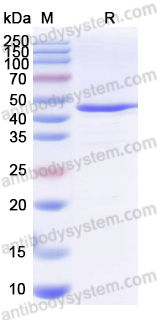
Antibody System Recombinant CU43 Protease (Human IgG Specific)
Overview
This recombinant CU43 Protease is a highly specialized, human IgG-specific endopeptidase cloned from Corynebacterium ulcerans and expressed via an advanced mammalian cell expression system. CU43 Protease represents a premium structural tool for high-resolution proteomics and biopharmaceutical analytical characterization. It functions by recognizing and cleaving human Immunoglobulin G (IgG) subclasses with high fidelity at a single unique site below the hinge region. This precise enzymatic action generates a highly homogenous pool of F(ab')2 fragments and separate Fc monomers, entirely removing the risks of non-specific or erratic over-digestion commonly associated with standard, non-restricted proteases like pepsin or papain.
The targeted cleavage profile of CU43 Protease makes it an outstanding analytical choice for bottom-up and middle-up mass spectrometry workflows, antibody-drug conjugate (ADC) domain subunit mapping, glycan distribution profiling, and structural quality control monitoring during commercial therapeutic antibody development. Expressed in mammalian cells, this version of the enzyme features an expanded predicted molecular weight of 70.94 kDa, which reflects native-like mammalian post-translational modifications and complex folding characteristics, offering unique performance benefits in specialized proteomic digestion matrices.
PRODUCT INFO
Key Features and Performance Metrics
-
Human IgG Specialization: Engineered for high-fidelity sequence recognition across human and humanized IgG frameworks, delivering reliable hinge-region cleavage and fragment uniformity.
-
Mammalian Expression Advantage: Produced in mammalian cells to achieve specialized structural folding dynamics, yielding a higher predicted molecular weight of 70.94 kDa that is highly optimized for complex biopharma sample matrices.
-
Refined Proteomic Purity: Exhibits a structural purity exceeding 90 percent, quantified and verified via Sodium Dodecyl Sulfate-Polyacrylamide Gel Electrophoresis (SDS-PAGE) to ensure a clean baseline free of interfering background proteins.
-
Premium Stock Concentration: Provided in a convenient liquid layout at a high concentration of 1.13 mg/ml to support direct integration into routine analytical titration protocols and serial dilution screens.
Technical Specifications
-
Catalog No.: EXX25001
-
Enzyme Family: Hinge-Specific Endopeptidase (Human IgG Target)
-
Source Species: Corynebacterium ulcerans
-
Expression System: Mammalian cells
-
Nature: Recombinant
-
Stock Concentration: 1.13 mg/ml
-
Predicted Molecular Weight: 70.94 kDa
-
Validated Application: Proteomics, Structural Mass Spectrometry, and Subunit Characterization
-
Endotoxin Level: Batch-specific; please contact technical services for current certificate of analysis metrics.
Alternative Names: CU43 Protease, CU43.
Applications and Workflow Summary
This mammalian-expressed recombinant enzyme is highly optimized for performance in structural biopharma characterization, top-down middle-up mass spectrometry sequencing, and antibody domain fragmentation. Investigators should observe the following guidelines:
-
Workflow Optimization: Optimal enzyme-to-substrate ratios, target concentrations, and required incubation times should be determined empirically by the investigator based on the specific IgG subclass, target mass (up to 5 mg per standard layout), and the unique constraints of the downstream assay.
-
Buffering Suitability: CU43 Protease displays peak enzymatic activity profiles in biological buffers maintained at or near neutral pH boundaries (pH 7.4). Standard physiological options—including conventional Phosphate Buffered Saline (PBS) or Tris-based systems—are fully compatible. Digestion layouts outside this neutral window should be optimized on a case-by-case basis.
-
Handling Precautions: To prevent physical shear stress, misfolding, or a sudden loss of catalytic activity, handle stock aliquots with care, work on ice during reaction assembly, and centrifuge the vial briefly prior to opening to collect all liquid contents.
Handling, Stability and Storage
-
Liquid Formulation: Supplied as a highly stable liquid solution adjusted to pH 7.4, supplemented with 50 percent glycerol cryoprotectant to preserve active-site folding dynamics.
-
Shipping Configurations: Distributed under secure, temperature-regulated parameters utilizing dry ice or chilled blue ice packs unless customized alternative shipping arrangements are established.
-
Storage Guidance:
-
Short-Term Storage: Maintain at 2 to 8 degrees C for immediate, short-term application needs (up to 1 week).
-
Long-Term Storage: For extended preservation, store continuously at -20 degrees C for a stable framework spanning 12 months from the initial date of batch receipt.
-
-
Operational Shelf Life: To avoid physical stress, structural denaturation, or sudden loss of catalytic activity, utilize a manual defrost freezer and strictly avoid repeated freeze-thaw cycles.
-