Antibody System Research Grade Cadonilimab
Overview
This research-grade monoclonal modality is engineered as a humanized bispecific antibody designed to simultaneously target two critical immune checkpoint receptors co-expressed on tumor-infiltrating lymphocytes: Programmed Cell Death Protein 1 (PD-1 / CD279) and Cytotoxic T-Lymphocyte-Associated Protein 4 (CTLA-4 / CD152). PD-1 and CTLA-4 operate via distinct, non-redundant inhibitory pathways to downregulate T-cell activation. While CTLA-4 functions predominantly during the early priming phase within peripheral lymphoid tissues by restricting CD28-mediated co-stimulation, PD-1 acts primarily during the structural effector phase within the tumor microenvironment to blunt proximal T-cell receptor cascades upon ligand engagement (PD-L1/PD-L2).
By concurrently targeting both receptors via a unique symmetric architecture, this bispecific molecule delivers dual-checkpoint blockade synergy. A hallmark of this specific molecular design is its cooperative binding profile: it displays higher avidity for cells dual-expressing PD-1 and CTLA-4 (such as highly exhausted tumor-infiltrating T cells) compared to cells expressing either receptor alone. This tumor-selective targeting enhances anti-tumor microenvironment efficacy while minimizing systemic immune-related adverse events (irAEs) typically associated with combination therapies of separate monospecific anti-PD-1 and anti-CTLA-4 antibodies. Developed as a high-fidelity research-grade biosimilar based on clone AK-104, cadonilimab features an IgG1-kappa-[scFv-heavy-lambda]2 symmetric tetravalent format where anti-PD-1 single-chain variable fragments (scFvs) are fused to the C-termini of a full-length anti-CTLA-4 IgG1 antibody. This platform serves as an essential analytical instrument for investigating cooperative immune checkpoint mechanics, mapping receptor co-localization, and optimizing multi-specific immunotherapies in preclinical solid tumor models.
PRODUCT INFO
Key Features and Performance Metrics
-
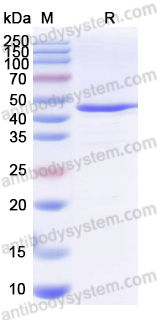
Refined Purity Profile: Exhibits an exceptional structural purity exceeding 95 percent, quantified and verified via Sodium Dodecyl Sulfate-Polyacrylamide Gel Electrophoresis (SDS-PAGE).
-
Uniform Working Concentration: Formulated at a precise stock concentration of 1 mg/ml to support direct in vitro functional assays, lymphocyte proliferation models, and serial titration layouts.
-
Symmetric Tetravalent Architecture: Formatted with an advanced [IgG1-kappa-[scFv-heavy-lambda]2] framework, establishing a bivalent configuration for both targets that ensures native-like structural stability, robust cross-linking kinetics, and reproducible dual-epitope binding avidity.
-
Validated Upstream Recovery: Isolated and polished using specialized Protein A/G affinity chromatography directly from cell culture supernatants to minimize processing contaminants.
Technical Specifications
-
Catalog No.: DHH02221
-
Targeted Biomarkers: PD-1 (Programmed cell death protein 1 / PDCD1) & CTLA-4 (Cytotoxic T-lymphocyte protein 4 / CTLA4)
-
Host Species: Humanized
-
Clonality: Monoclonal
-
Clone ID: Cadonilimab (AK-104 / AK104)
-
Isotype: IgG1-kappa-[scFv-heavy-lambda]2 Bispecific
-
Species Reactivity: Human
-
Accession Numbers: Q15116 (PD-1) & P16410 (CTLA-4)
-
Endotoxin Level: Batch-specific; please contact technical services for current certificate of analysis metrics.
Alternative Names: Tetravalent Bispecific PD-1 x CTLA-4, AK-104, AK104, Protein PD-1, hPD-1, PDCD1, CD279, CD152, Cytotoxic T-lymphocyte-associated antigen 4, CAS: 2394841-59-7.
Applications and Workflow Summary
This humanized bispecific molecule is highly optimized for performance as a research-grade biosimilar in downstream preclinical models. Investigators should observe the following guidelines:
-
Dilution and Layout: Optimal operational concentrations must be determined empirically based on specific assay configurations, such as mixed lymphocyte reactions (MLR), T-cell activation screenings (measuring IL-2 or IFN-γ secretion), flow cytometry-based co-expression screening, or surface plasmon resonance (SPR) binding kinetics.
-
Matrix Suitability: Due to its avidity-driven cooperative binding mechanism, this construct is uniquely suited for characterization alongside independent anti-PD-1 or anti-CTLA-4 reference standards to evaluate selective binding thresholds on dual-positive vs. single-positive lymphocyte sub-populations.
-
Handling Precautions: To prevent physical shear stress, misfolding, or structural degradation of the C-terminally linked scFv domains, handle stock aliquots with care and centrifuge the vial briefly prior to opening.
Handling, Stability and Storage
-
Liquid Formulation: Supplied in a highly stable liquid format dissolved in 0.01M Phosphate Buffered Saline (PBS), pH 7.4.
-
Storage Guidance:
-
Short-Term Storage: Maintain at 4°C for standard short-term use (1 to 2 weeks).
-
Long-Term Storage: For intermediate storage up to 12 months, keep at -20°C. For extended long-term preservation, store at -80°C.
-
-
Operational Shelf Life: To prevent structural chain fragmentation and preserve functional bispecific binding capabilities across all active variable domains, use a manual defrost freezer and strictly avoid repeated freeze-thaw cycles.
-