Antibody System Research Grade Runimotamab
Overview
This research-grade monoclonal modality is engineered as a humanized bispecific T-cell engager (TCE) designed to simultaneously target the Human Epidermal Growth Factor Receptor 2 (HER2/neu, ErbB2) on malignant cells and the Cluster of Differentiation 3 epsilon subunit (CD3e) on the T-cell receptor complex (Modi et al., 2025). HER2 is a well-characterized proto-oncogenic receptor tyrosine kinase aberrantly amplified or overexpressed across numerous epithelial malignancies, notably breast, gastroesophageal, ovarian, and lung cancers, where it drives aggressive proliferative signaling via the MAPK and PI3K/Akt pathways (Rubin et al., 2024). By concurrently bridging HER2-expressing tumor architectures with CD3e, this bispecific molecule forces the spatial formation of a cytolytic immunological synapse that entirely bypasses normal major histocompatibility complex class I (MHC-I) antigen restriction (Brogna et al., 2026; Garcia-Lorenzo, 2026). This directional alignment triggers robust, localized T-cell proliferation and the polarized exocytosis of perforins and granzymes, culminating in targeted apoptosis of the HER2-positive neoplastic lineages (Garcia-Lorenzo, 2026).
Developed as a high-fidelity research-grade biosimilar based on clone BTRC-4017A (RG-6194), runimotamab provides an essential preclinical platform for mapping immune-mediated lysis kinetics, evaluating combination therapy options with conventional anti-HER2 antibodies to limit low-expressing normal tissue cross-reactivity, and resolving mechanisms of T-cell exhaustion within the solid tumor microenvironment (Modi et al., 2025; Spinazzola et al., 2025).
PRODUCT INFO
Key Features and Performance Metrics
-
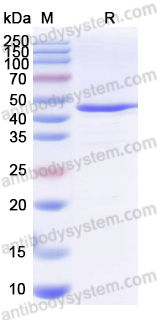
Refined Purity Profile: Exhibits an exceptional structural purity exceeding 95 percent, quantified and verified via Sodium Dodecyl Sulfate-Polyacrylamide Gel Electrophoresis (SDS-PAGE).
-
High-Yield Stock Concentration: Formulated at a precise concentration of 1.57 mg/ml to support direct in vitro functional assays, co-culture screens, and precise serial dilution workflows.
-
Humanized Bispecific Architecture: Engineered as an IgG1-Kappa heterodimeric assembly via advanced mammalian cell expression, providing native-like glycosylation profiles, structural stability, and reproducible target binding with minimized anti-species immunogenicity.
-
Validated Upstream Recovery: Isolated and polished using specialized Protein A/G affinity chromatography directly from cell culture supernatants to minimize processing contaminants.
Technical Specifications
-
Catalog No.: DHC09612
-
Targeted Biomarkers: HER2 (Receptor tyrosine-protein kinase erbB-2 / ERBB2) & CD3 epsilon chain (CD3E)
-
Host Species: Humanized
-
Clonality: Monoclonal
-
Clone ID: Runimotamab (BTRC-4017A / RG-6194)
-
Isotype: IgG1-Kappa Bispecific
-
Species Reactivity: Human
-
Accession Numbers: P04626 (HER2) & P07766 (CD3E)
-
Endotoxin Level: Batch-specific; please contact technical services for current certificate of analysis metrics.
Alternative Names: Bispecific HER2 x CD3, BTRC-4017A, RG-6194, p185erbB2, Neuro/Glioblastoma Derived Lymphocyte Differentiation Antigen (NGL), Proto-oncogene Neu, CD340, T3E, CAS: 2361325-98-4.
Applications and Workflow Summary
This humanized bispecific molecule is highly optimized for performance as a research-grade biosimilar in downstream preclinical models. Investigators should observe the following guidelines:
-
Dilution and Layout: Optimal operational concentrations must be determined empirically based on specific assay configurations, such as T-cell-directed cytotoxicity screenings, cytokine (IFN-γ / TNF-α) induction assays, flow cytometry-based binding studies, or surface plasmon resonance configurations.
-
Analysis Requirements: Because runimotamab can be utilized alongside established anti-HER2 monoclonal antibodies (such as trastuzumab) to analyze target competition, receptor occupancy, and mitigation profiles of on-target/off-tumor cross-reactivity, assays should be carefully controlled for target expression levels (Modi et al., 2025).
-
Handling Precautions: To prevent physical shear stress or structural degradation of the heterodimeric links, handle stock aliquots with care and centrifuge the vial briefly prior to opening.
Handling, Stability and Storage
-
Liquid Formulation: Supplied in a highly stable liquid format dissolved in 0.01M Phosphate Buffered Saline (PBS), pH 7.4.
-
Storage Guidance:
-
Short-Term Storage: Maintain at 4°C for standard short-term use (1 to 2 weeks).
-
Long-Term Storage: For intermediate storage up to 12 months, keep at -20°C. For extended long-term preservation, store at -80°C.
-
-
Operational Shelf Life: To prevent structural chain fragmentation and preserve functional bispecific binding capabilities across both arms, use a manual defrost freezer and strictly avoid repeated freeze-thaw cycles.
-