Antibody System Research Grade Tarlatamab
Overview
This research-grade monoclonal modality is engineered as a first-in-class, half-life extended bispecific T-cell engager (BiTE) designed to simultaneously bind to Human Delta-like Ligand 3 (DLL3) and the Cluster of Differentiation 3 epsilon subunit (CD3e) on the T-cell receptor complex (Paz-Ares et al., 2023). DLL3 is a non-canonical Notch pathway ligand that is minimal or absent in normal adult tissues but aberrantly overexpressed on the cell surface in 70 percent to 80 percent of small cell lung cancer (SCLC) and other high-grade neuroendocrine tumors (Ji et al., 2025; Wang et al., 2026). By concurrently bridging the neuroendocrine tumor surface marker DLL3 and CD3e, this construct bypasses major histocompatibility complex class I (MHC-I) antigen presentation constraints to force structural cytolytic synapse formation (Alamgir et al., 2024). This directional coupling drives robust T-cell activation, localized interferon-gamma secretion, and the directed release of perforins and granzymes, resulting in highly selective cytotoxicity against DLL3-positive neoplastic lineages (Abdelmoaty, 2024; Tang & Kang, 2023). Developed as a high-fidelity research-grade biosimilar based on clone AMG-757, this engineered multidomain format serves as an essential analytical instrument for immuno-oncologists and pharmacologists mapping redirection kinetics, investigating resistance mechanisms, and establishing checkpoint synergy layouts in preclinical solid tumor networks (Ji et al., 2025).
PRODUCT INFO
Key Features and Performance Metrics
-
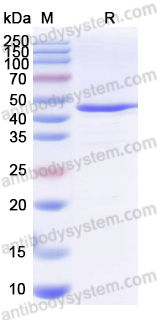
Refined Purity Profile: Exhibits an exceptional structural purity exceeding 95 percent, quantified and verified via Sodium Dodecyl Sulfate-Polyacrylamide Gel Electrophoresis (SDS-PAGE).
-
Custom Formulated Concentration: Supplied at a standard working stock concentration of 0.64 mg/ml to seamlessly accommodate routine in vitro cell lysis assays and titration optimization steps.
-
Advanced Multi-Domain Engineering: Formatted with a specialized (scFv-heavy-kappa)-(scFv-heavy-lambda)-scFc isotype structure, mimicking native-like post-translational binding kinetics while optimizing serum half-life parameters via its single-chain Fc backbone (Ji et al., 2025).
-
Validated Upstream Recovery: Isolated and polished via specialized Protein A/G affinity chromatography directly from cell culture supernatants to minimize processing contaminants.
Technical Specifications
-
Catalog No.: DHK06402
-
Targeted Biomarkers: Delta-like protein 3 (DLL3) & CD3 epsilon chain (CD3E)
-
Host Species: Humanized
-
Clonality: Monoclonal
-
Clone ID: Tarlatamab (AMG-757)
-
Isotype: (scFv-heavy-kappa)-(scFv-heavy-lambda)-scFc
-
Species Reactivity: Human
-
Accession Numbers: Q9NYJ7 (DLL3) & P07766 (CD3E)
-
Endotoxin Level: Batch-specific; please contact technical services for current certificate of analysis metrics.
Alternative Names: AMG-757, AMG757, Drosophila Delta homolog 3, Delta3, T3E, T-cell surface antigen T3/Leu-4 epsilon chain, CAS: 2307488-83-9.
Applications and Workflow Summary
This humanized bispecific molecule is highly optimized for performance as a research-grade biosimilar in downstream preclinical models. Investigators should observe the following guidelines:
-
Dilution and Layout: Optimal operational concentrations should be determined empirically by the investigator based on specific assay layouts (e.g., T-cell-directed cytotoxicity screenings, cytolytic synapse imaging, flow cytometry binding assays, or surface plasmon resonance configurations).
-
Analysis Requirements: To avoid physical shear stress or structural degradation of the multi-domain scFv fragments, always handle stock aliquots with care and centrifuge the vial briefly before opening to collect the liquid contents.
Handling, Stability and Storage
-
Liquid Formulation: Supplied in a highly stable liquid format dissolved in 0.01M Phosphate Buffered Saline (PBS), pH 7.4.
-
Storage Guidance:
-
Short-Term Storage: Maintain at 4°C for standard short-term use (1 to 2 weeks).
-
Long-Term Storage: For intermediate storage up to 12 months, keep at -20°C. For extended long-term preservation, store at -80°C.
-
-
Operational Shelf Life: To prevent structural fragmentation and preserve structural binding capability across both single-chain arms, use a manual defrost freezer and strictly avoid repeated freeze-thaw cycles.
-