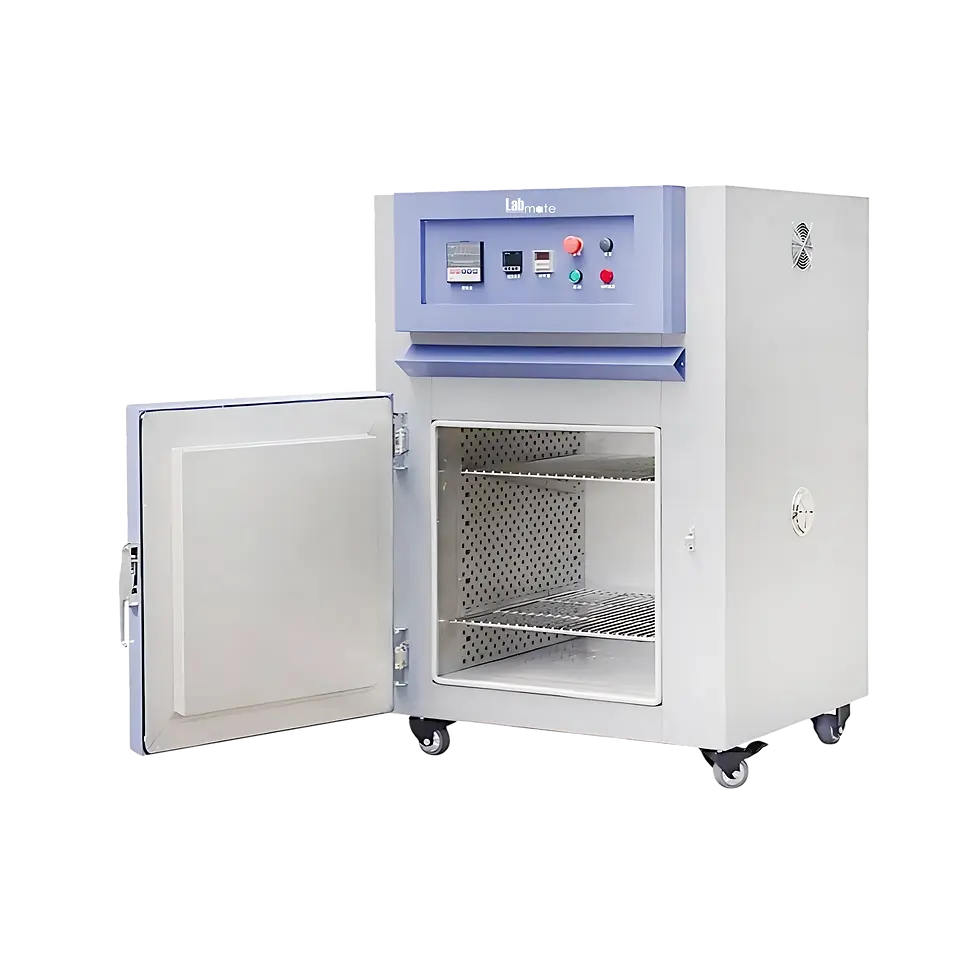
Labmate Forced Convection Oven LMFO-A201
Labmate Forced Convection Oven LMFO-A201 delivers precise temperature control, excellent uniformity, and rapid recovery performance for demanding laboratory and industrial environments. Designed with a fan-assisted air circulation system and adjustable ventilation, it ensures consistent heat distribution throughout the chamber. The triple-paned high-temperature safety glass window enhances operational safety, while the compact 49 L chamber supports efficient processing with reliable thermal accuracy.
Product Info
Key Features
-
Fan-assisted forced convection system for uniform temperature distribution
-
Temperature range up to 250 °C with fast ramp-up and recovery
-
Digital PID controller with 5 patterns and 18 programmable steps
-
Triple-paned high-temperature safety glass window for implosion protection
-
SSR temperature regulation with K-type thermocouple
-
Over-temperature limit, sensor alarm, and circuit breaker safety protection
-
Adjustable ventilation opening for airflow and exhaust control
-
Height-adjustable stainless-steel shelves
-
Low-noise operation with gentle air circulation
-
Quick auto start and auto stop functionality
-
Insulated chamber and door for thermal efficiency
Specifications
Specification Details Capacity 49 L Temperature Range Ambient ±10 °C to 200 °C (Max 250 °C) Temperature Accuracy ±0.5 °C Timer 99 hr 59 min Shelves 2 EA (height adjustable, up to 3 optional) Temperature Controller Digital PID controller, 5 patterns, 18 steps Temperature Regulator SSR Thermocouple K (CA type) Insulation Glass wool Window High-temperature safety glass, triple-paned Safety Device Circuit breaker, sensor alarm Fan Motor 1–16 HP Heater Capacity 1 kW Power Supply AC 220 V, 50/60 Hz, 1ɸ Internal Material Stainless steel External Material Powder-coated steel plate Internal Dimensions (W×D×H) 350×400×350 mm External Dimensions (W×D×H) 500×560×810 mm Applications
Labmate Forced Convection Oven LMFO-A201 is suitable for drying laboratory glassware, heat-sensitive materials, sterilization, aging, curing, softening, annealing, and residue-free drying of precision components. It is also widely used for temperature control applications in life sciences, research laboratories, and material testing across industrial environments.-