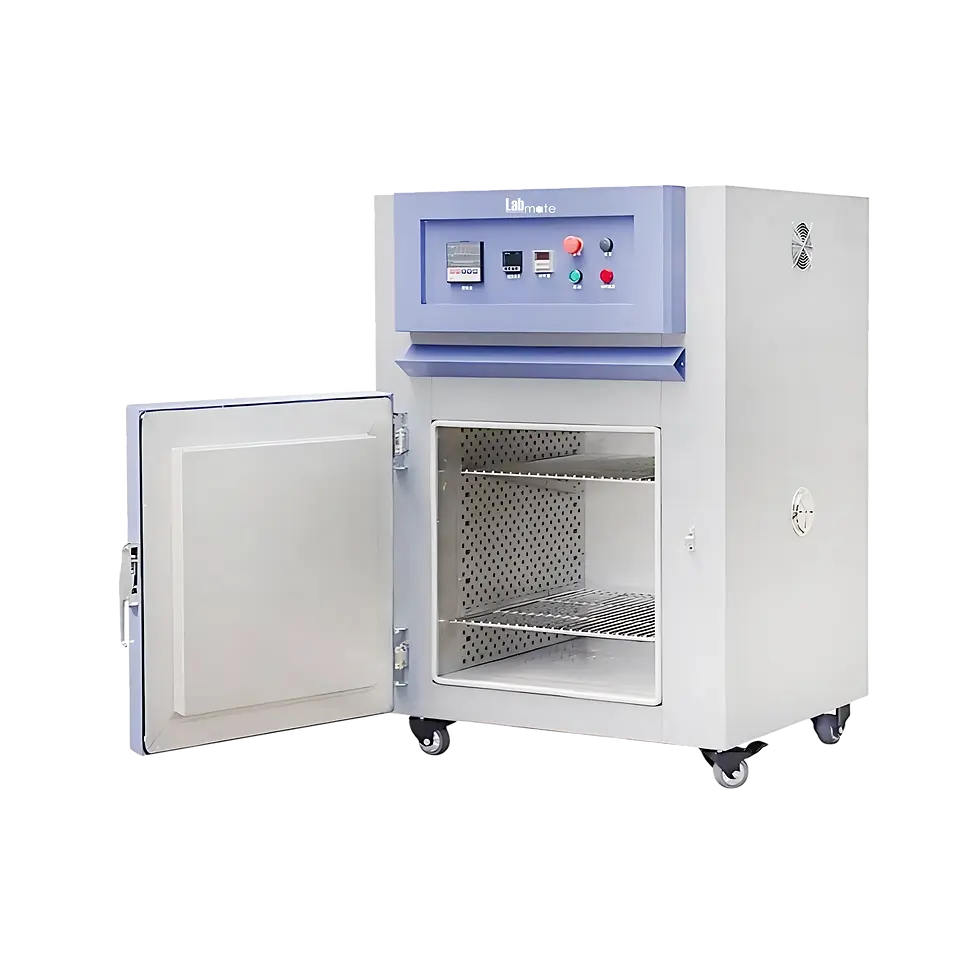
Labmate Dual Chamber Forced Convection Oven LMDO-A301
Labmate Dual Chamber Forced Convection Oven LMDO-A301 delivers high temperature consistency, rapid recovery, and precise control for laboratory drying, sterilization, and thermal processing. With dual 91 L chambers, fan-assisted airflow, and adjustable exhaust vents, it ensures uniform heat distribution and safe operation. The triple-paned safety glass window provides enhanced protection, while digital PID control allows complex program settings for versatile laboratory applications.
Product Info
Key Features
-
Dual 91 L chambers with fan-assisted air circulation for uniform temperature
-
Temperature range: Amb ±10 °C to 200 °C, Max 250 °C; accuracy ±0.5 °C
-
Digital PID controller with 5 patterns and 18 programmable steps
-
SSR temperature regulator and K-type thermocouple
-
Triple-paned high-temperature safety glass window for implosion protection
-
Insulated with glass wool for thermal efficiency
-
Over-temperature limit function, sensor alarms, and circuit breaker for safety
-
4 adjustable stainless-steel shelves per chamber
-
Easy-to-use control panel with separate display for set and actual temperatures
-
Quick auto start/stop and fast recovery time when doors are opened
-
Low-noise operation with gentle airflow
Specifications
Specification Details Capacity 91 L × 2 chambers Temperature Range Amb ±10 °C to 200 °C (Max 250 °C) Temperature Accuracy ±0.5 °C Timer 99 hr 59 min Shelves 4 EA (height adjustable) Temperature Controller Digital PID, 5 pattern, 18 steps Temperature Regulator SSR Thermocouple K (CA type) Insulation Glass wool Window High-temperature safety glass, triple-paned Safety Device Circuit breaker, sensor alarm Fan Motor 1–16 HP Heater Capacity 2.4 kW Power AC 220 V, 50/60 Hz, 1ɸ Internal Material Stainless steel External Material Steel plate, powder-coated Internal Dimensions (W×D×H) 450×450×450 mm × 2 chambers External Dimensions (W×D×H) 1020×720×1420 mm Applications
Labmate LMDO-A301 is ideal for drying laboratory glassware, heat-sensitive materials, sterilization, aging, curing, softening, annealing, and residue-free drying of intricate parts. It also supports precise temperature control for life sciences, research, and material testing in industrial and laboratory settings.-