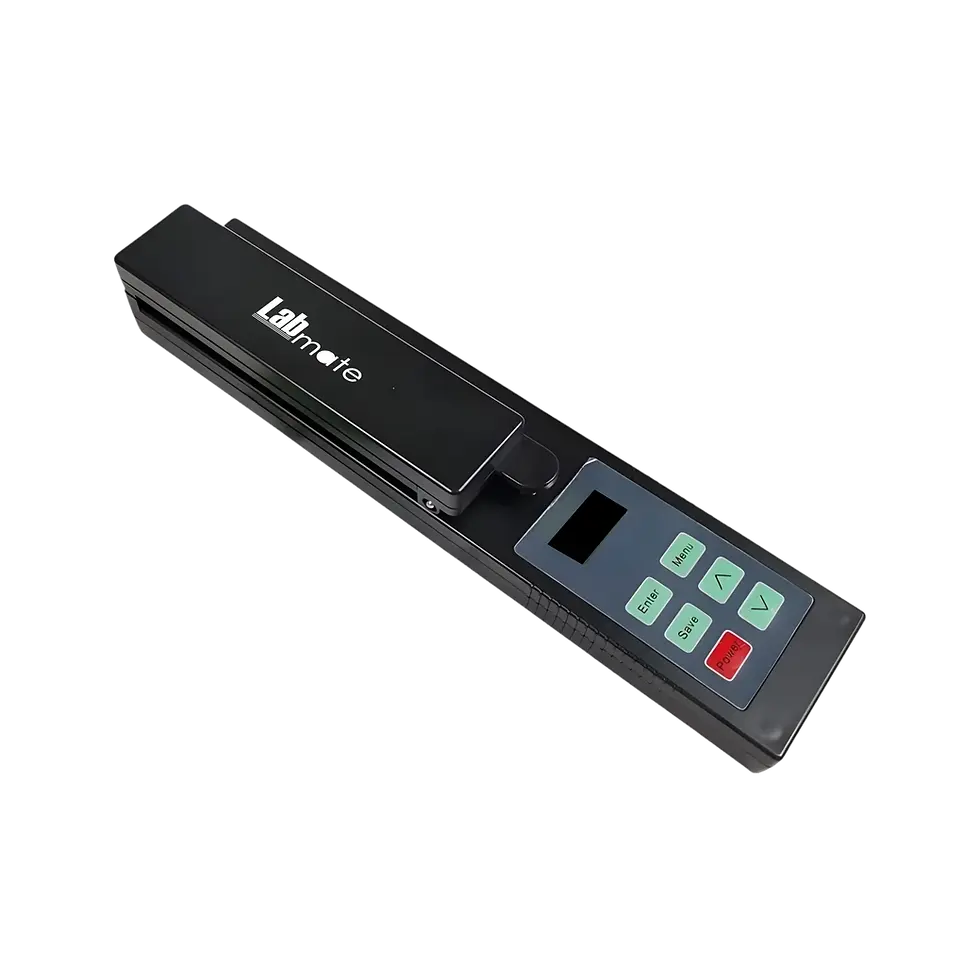
Labmate Leaf Area Meter LMLAM-A101
Labmate Leaf Area Meter LMLAM-A101 utilizes 470 nm blue light wavelength to enhance plant surface definition, enabling precise and rapid leaf area measurements. With a scanning width of 220 mm and capacity to handle samples up to 6 mm thick, it accommodates larger and mature botanical specimens without manual repositioning. The device supports multiple measurement units (mm, mm², cm²) and features a 5-inch color touchscreen for intuitive operation and data visualization.
Product Info
Key Features
-
CIS (Contact Image Sensor) technology for accurate scanning
-
Blue light wavelength: 470 nm for enhanced plant surface detection
-
Scanning width: 220 mm, suitable for larger leaves
-
Sample thickness: up to 6 mm
-
Measurement units: mm, mm², cm²
-
Area resolution: 1 mm²; length/width resolution: 0.1 mm
-
High-speed scanning: 1 ms per line
-
Two sets of rubber rollers with automatic import/export slots
-
5-inch color touchscreen (800×480 dot matrix)
-
USB 2.0 data interface for seamless data transfer
-
Operating environment: 0–50 °C, 0–90% RH
-
Rechargeable lithium battery
-
Compact and lightweight for portable use
Standard Accessories
Model No. Name LMLAM-A101-M1 Main Unit LMLAM-A101-C1 Charger LMLAM-A101-D1 Data Transmission Line LMLAM-A101-U1 U Disk LMLAM-A101-I1 Instrument Case Technical Highlights
Parameter Specification Sensor Type CIS Contact Image Sensor Blue Light Wavelength 470 nm Scanning Speed 1 ms Scanning Width 220 mm Measurement Units mm, mm², cm² Measurement Accuracy ±2% (for sample area >20 cm²) Area Resolution 1 mm² Length/Width Resolution 0.1 mm Sample Thickness 6 mm Conveyor Belt Module Two sets of rubber rollers with auto import/export Data Interface USB 2.0 Display 5-inch color touchscreen, 800×480 Working Environment 0–50 °C, 0–90% RH Power Supply Rechargeable lithium battery Dimensions 280 × 140 × 120 mm Net Weight 1.5 kg Applications
Labmate LMLAM-A101 is ideal for rapid, accurate measurement of multiple detached leaves, supporting research in plant morphology, physiology, canopy density studies, forest productivity assessment, and tree health evaluation.
This model combines speed, precision, and portability, making it suitable for both laboratory and field studies.
-